Composite bonding is suitable for individuals with healthy teeth, healthy gums, moderate cosmetic concerns, and realistic expectations regarding durability and maintenance. However, dental bonding is a bad choice for people with gum disease, excessive chewing forces, severe misalignments, or major fractures.
Therefore, teeth bonding is particularly suitable for those seeking conservative healing without the need for more extensive dental treatment.
In this article, we will explain in detail when composite bonding treatment might be a poor option, who it might be suitable for, and what the general expectations should be for this treatment.
What is Dental Bonding?
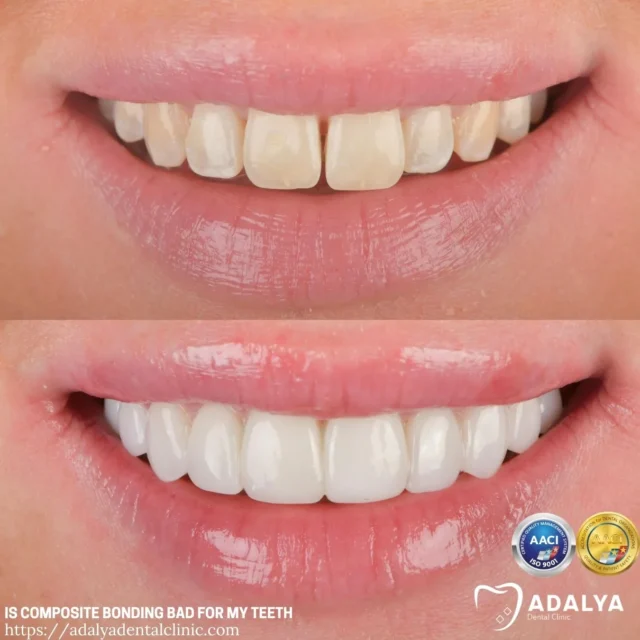
Composite bonding is a dental procedure that involves applying tooth-colored resin material to teeth to improve their appearance. This material can be molded and shaped to correct various dental problems such as fractures, cracks, discoloration, or slight misalignment.
However, while dental bonding offers many benefits, it’s essential to understand who might not be an ideal candidate for this treatment and the factors to consider before undergoing the procedure.
What Condition Are Bad For Composite Bonding?
Composite bonding is not suitable for everyone because it works best on healthy teeth and gums with relatively minor cosmetic concerns. However, for people with noticeable deformities of the teeth, gum disease or orthodontic problems, composite bonding is actually a bad choice for their teeth.
Below, we have summarized the situations in which composite bonding may be bad option for the teeth.
Who May Not Be Suitable for Composite Bonding?
- Severe Tooth Decay: Decay should be treated first.
- Active Gum Disease: Healthy gums are essential before treatment.
- Severe Teeth Grinding (Bruxism): Grinding may cause bonding to chip or break.
- Major Bite Problems: Significant bite issues may put excessive pressure on the bonding.
- Severely Damaged Teeth: Crowns or other restorative treatments may be more suitable.
- Very Large Gaps: Some gaps may require orthodontic treatment instead.
- Significantly Misaligned Teeth: Orthodontics may provide a better long-term result.
- Poor Oral Hygiene: Good daily oral care is important for maintaining bonding.
- Unrealistic Expectations: Composite bonding has aesthetic and functional limitations.
- Patients Seeking Maximum Stain Resistance: Composite can stain more easily than porcelain.
- Patients Requiring Major Colour Changes: Veneers or other treatments may be more appropriate.
People With Active Tooth Decay or Untreated Dental Disease
If you have any untreated tooth decay, an infection or pain, you should postpone your composite bonding treatment until these issues have been diagnosed and treated.
Because placing a dental bonding in a damaged tooth can make it difficult to monitor the problem and may result in you needing more extensive treatment later on.
Warning Signs to Discuss Before Bonding:
- Toothache, sensitivity that is getting worse, or pain when biting.
- Visible holes, dark areas, or crumbling edges.
- Swelling, pus, a bad taste, or recurring gum abscesses.
- A tooth that has fractured deeply or changed colour after trauma.
- Old fillings or restorations that feel loose or sharp.
People With Gum Disease Or Poor Gum Stability
Gum health is important because composite bonding are placed on the surface of the tooth, usually near the gum line. Gum disease can cause red, swollen, painful, or bleeding gums and is linked to plaque buildup around the teeth.
If gums are inflamed, bleeding, or receding, dental bonding can be more difficult to apply cleanly and maintain afterward. In conclusion, composite bonding applied before the gum disease problem is resolved can lead to bigger problems for the individual.
Heavy Teeth Grinders and Strong Clenchers
People who grind or clench heavily are often less suitable for composite bonding, especially on biting edges. If grinding is uncontrolled, bonded edges may chip, wear, or detach more easily.
Suitability for composite bonding should always be assessed individually by a dentist after examining the teeth, gums and bite.
People With Severe Crowding, Bite Problems, or Major Tooth Position Issues
Teeth bonding can conceal small gaps, uneven edges, and minor shape issues, but they don’t move teeth into healthier positions. If teeth are crowded, rotated, protruding, or irregularly positioned, adding resin can sometimes make the tooth appear thicker or create areas that are difficult to clean.
However, in cases where tooth positioning is the main issue, orthodontic treatment may be recommended before dental bonding. Because it can provide a better foundation, reduce the amount of resin needed, and help the final shape look more natural.
People With Extensive Tooth Wear Or Large Structural Damage
Dental bonding is generally best suited for minor cosmetic or structural corrections. However, if a tooth’s enamel layer is significantly reduced, if it has a deep fracture, or if there is extensive wear on multiple teeth, a filling alone may not provide sufficient strength or protection.
Therefore, for extensive damage, it is more appropriate to consider onlays, crowns, veneers, bite rehabilitation, or a combined approach.
3D Smile Design Technology with Adalya Dental Clinic
Great Results in Dental Implants & All Treatments in Turkey
Get In Touch With Adalya Dental Clinic!
Who Should Avoid Composite Bonding For Cosmetic Expectations?
Composite bonding is often strongest as a conservative option for small or big refinements. However, it is not ideal for people who expect a permanent, stain-proof, completely maintenance-free smile makeover.
If you want a very bright color tone, significant tooth alignment changes, or a fairly permanent complete smile transformation, you might consider orthodontics, porcelain veneers, or crowns instead of composite bonding.
Expectations That May Mot Match Dental Bonding
Composite bonding may disappoint you if you want:
- A result that never stains or dulls.
- A major colour change without whitening the natural teeth first.
- A way to straighten crowded teeth without addressing alignment.
- Long extensions on short teeth where the bite is already heavy.
- A one-time treatment with no polishing, maintenance, or future repairs.
A good consultation should include not only what dental bonding can do, but also what it cannot do. That conversation is part of responsible composite bonding suitability assessment.
Contact Us > Whatsapp
Who is Suitable For Composite Bonding?
Suitable candidates for composite bonding are typically individuals with generally healthy teeth and gums who wish to correct minor to moderate cosmetic issues rather than major structural or alignment problems.
Teeth bonding candidates often have minor imperfections that affect the appearance of their smile but do not require extensive restorative dentistry, orthodontics, or crowns.
Suitable Cases For Teeth Bonding
- Small chips on front teeth (8-10 Teeth)
- Minor cracks or rough edges
- Narrow gaps between teeth
- Slightly uneven tooth length or shape
- Localised discolouration that does not respond well to whitening
- Mild wear on biting edges
- Small cosmetic asymmetries in the smile line
Realistic expectations are just as important as oral health. Composite bonding can make a noticeable difference, and these differences, when combined with porcelain veneers or crowns, can completely transform your teeth.
As Adalya Dental Clinic, we provide these differences with our expert cosmetic dentist in composite bonding treatments in Turkey, Antalya.
The Advantages of Composite Bonding For The Right Person
The advantages of composite bonding are strongest when the desired change is modest and the teeth are otherwise healthy. Compared with more invasive options, bonding often preserves more natural tooth structure because little to no drilling may be needed.
Therefore, for many people, that conservative approach is the main reason to consider it. Another benefit is speed. Bonding can often be completed more quickly than treatments that require laboratory-made restorations.
Common Composite Bonding Benefits
- Minimal alteration to natural teeth: The surface may need gentle preparation, but bonding is generally more conservative than crowns and often less invasive than veneers.
- Natural-looking cosmetic improvement: The resin can be shaped and polished to blend with nearby teeth.
- Quick repairability: Small chips or rough areas can often be repaired or refreshed without replacing the whole restoration.
- Lower upfront commitment: It can be a more accessible cosmetic option than some alternatives, although fees vary by case and clinic.
- Useful for trialling changes: Because bonding is conservative, it can sometimes help patients explore changes in tooth shape before choosing a longer-term option.
- Fast completion: Unlike other cosmetic veneers and crowns that take 5-7 days or longer, it can be completed in a maximum of 4-5 hours in 1 day.
However, all these advantages apply only to individuals for whom composite bonding treatment is suitable. For unsuitable individuals, composite bonding can lead to bad results or disappointment.
looking for dental treatments abroad?
Affordable Turkey Teeth Package Deals With Us
Check Out Our Pages And Reach Our Expert Team
Common Misconceptions About Composite Bonding
Composite bonding is a versatile and effective dental solution that can address a wide range of cosmetic concerns, from chipped and cracked teeth to gaps and discoloration.
Its minimally invasive nature, quick procedure time, and affordability make it an attractive option for many individuals looking to enhance their smile.
However, there are several common misconceptions about composite bonding that can lead to confusion or unrealistic expectations.
Some Misconception About Composite Bonding
Misconception 1
One misconception is that composite bonding is a permanent solution. While the results of composite bonding can last for several years with proper care, the bonded material is not as durable as natural tooth enamel or other restorative materials.
Misconception 2
Another misconception is that composite bonding can address all types of dental issues. While composite bonding is highly versatile, it is most effective for minor to moderate cosmetic concerns.
More complex dental problems, such as severe misalignment or extensive decay, may require alternative treatments.
Misconception 3
Some patients may also believe that composite bonding is a completely painless procedure. While composite bonding is minimally invasive and typically requires little to no anesthesia, some patients may experience mild sensitivity or discomfort during the procedure.
FAQ'S
By reviewing the frequently asked questions, you can find information about composite bonding teeth, such as who they are suitable for, their lifespan, duration, processing time, and cost.
Composite bonding does not damage teeth during or after the procedure. However, the skill of the dentist is crucial. Proper technique ensures no unnecessary wear or damage. Therefore, choosing a qualified and experienced dentist reduces risks.
The procedure is minimally invasive and preserves tooth structure.
Composite bonding treatment takes for single tooth between 30-45 minutes. However, full mouth treatments covering 16–20 teeth can take 5–6 hours for a single jaw, and the dentist may complete the treatment in 2 sessions.
Yes, composite bonding can stain, but it does not stain in exactly the same way as natural enamel. Many people enjoy excellent cosmetic results from composite bonding, particularly when they understand that it is not completely immune to colour change.
Over time, the surface can become dull, rough, or slightly discoloured, especially if it is exposed to strong staining agents or if the polish wears down.
Composite bonding teeth last between 5-10 years, depending on the experience of the dentist, the use of the person and the quality of the material used by the dentist.
However, since composite bonding is not a permanent treatment and discoloration may occur over time, renewal may be needed on composite bonding after 5 years on average.
The price of composite teeth ranges from $350-$500 in USD, £300-£400 in the UK, and €250-€350 in Germany. However, composite bonding cost in Turkey, which offers affordable dental tourism opportunities, is between £100-£200 ($135-$260).
In Turkey, we provide high-quality, long-lasting treatments at affordable prices with our expert cosmetic dentistry team. You can evaluate our quality by reviewing our composite bonding before and after photos.
Composite bonding after 5 years show some signs over time that will require renewal. These signs; It appears as minor abrasions, breaks and discoloration.
However, this situation cannot be at the same level for everyone. Because it produces different results in people by paying attention to oral hygiene and paying attention to what they eat.
Many wonder if they can whiten composite bonding like natural teeth. Unfortunately, traditional whitening methods are ineffective for composite bonding teeth. Because composite bonding is made from resin material that is not reactive to bleaching agents.