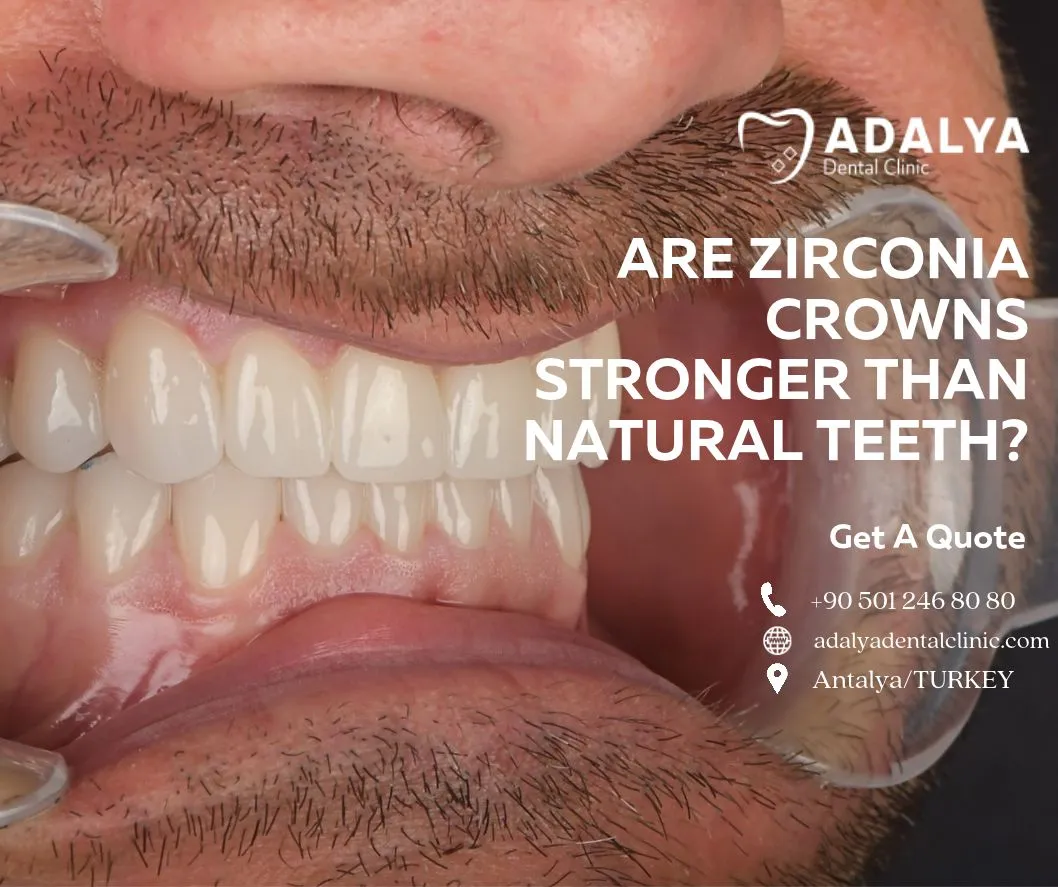
Zirconia crowns are often stronger than natural teeth when you look at fracture resistance and material strength. But that does not mean they are “better” than healthy tooth structure in every way. Although zirconia crowns are stronger and more fracture-resistant than natural tooth enamel; however, natural teeth have biological advantages that zirconia cannot copy.
Zirconia has been reported with flexural strength around 900–1200 MPa, which is one reason it is widely used for posterior crowns and other high-load dental restorations.
In addition, natural teeth enamel is very hard, but it is also brittle and supported by dentin, roots, and the periodontal ligament. So a real tooth behaves differently from a ceramic crown under daily chewing forces.
Understanding Zirconia Crowns and Natural Teeth
Zirconia crowns score highly in fracture resistance and flexural strength, but natural teeth have a layered structure that distributes force in a more biological way.
Natural tooth enamel is the hard outer shell. However, dentin underneath is softer and more resilient. Additionally, the periodontal ligament around the root adds a shock-absorbing effect that a crown material itself does not have.
But a zirconia crown sits on a prepared tooth and becomes part of that tooth-restoration system, and the ceramic itself does not have nerves, blood supply, or a ligament.
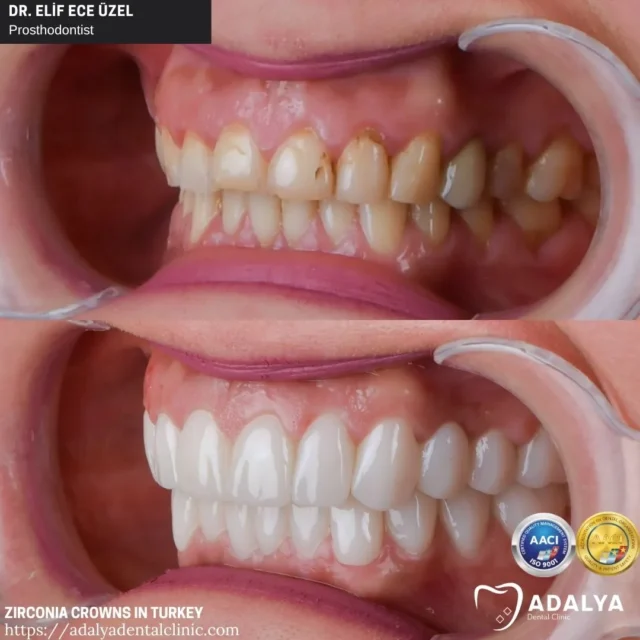
This is why a zirconia crown can be stronger than natural tooth enamel in a lab-style material comparison while still needing careful dental planning in the mouth. Because the crown, tooth, cement, gum tissue, and opposing teeth all work together.
Are Zirconium Crowns Really Stronger Than Natural Teeth?
By most laboratory measures, yes, a zirconia crown is measurably harder and stronger than natural tooth structure, though reported values vary with composition, sintering, surface finish and test method.
Additionally, a zirconia crown’s vickers hardness sits roughly 2 to 4 times higher than natural tooth enamel, and its flexural strength is several times greater than either enamel or dentine.
However, whether that translates into a better outcome in your mouth, depends on the type of zirconia chosen, the precision with which it was made, and how it is managed clinically.
What do laboratory findings show in the comparison of zirconia crown strength and natural tooth strength?
Strength means different things in different tests. So anchoring the comparison in actual numbers is useful. The table below draws from published dental-materials studies and shows where each tissue or material sits.
| Material | Vickers hardness (HV) | Flexural strength (MPa) |
|---|---|---|
| 3Y-TZP Zirconium | Approx. 1,200–1,400 HV | Approx. 900–1,400 MPa |
| 4Y-PSZ Zirconium | Approx. 1,200–1,300 HV | Approx. 600–1,000 MPa |
| 5Y-PSZ Zirconium | Approx. 1,200–1,400 HV | Approx. 400–900 MPa |
| Human Enamel | Approx. 300–600 HV | Approx. 60–200 MPa |
| Human Dentine | Approx. 60–100 HV | Approx. 230–305 MPa |
One representative study measured zirconia at 1,454 HV versus enamel at 372 HV, a ratio of almost 4:1. In practical terms, zirconia can withstand far greater occlusal load before fracturing and resists surface scratching significantly better than enamel.
However, values vary with yttria content, sintering schedule, surface finish, and the test method used, so individual figures across studies will differ.
Key Facts At A Glance
- Zirconia outperforms enamel in the lab: 3Y-TZP zirconia measures approximately 1,200–1,400 HV Vickers hardness versus roughly 300–600 HV for enamel, making it 2 to 4 times harder.
- Monolithic designs last longer: Clinical data show approximately 86% survival at 10 years for monolithic zirconia crowns versus 71% for veneered designs in one retrospective cohort.
- Polishing matters more than most patients realise: Polished zirconia causes far less wear to opposing teeth than roughened or glazed surfaces; any chairside adjustment must be followed by re-polishing.
- Bruxism is a leading risk factor: Most catastrophic zirconia fractures documented in clinical reviews occurred in patients showing signs of parafunctional habits.
- CAD-CAM fit affects long-term durability: Digital scanning and precision milling reduce marginal gaps and internal misfits, lowering the risk of stress fractures and secondary decay.
- Grade selection depends on position: 3Y-TZP is suited to molars and heavy loads; 4Y or 5Y grades offer better aesthetics for anterior restorations at slightly lower strength.
3D Smile Design Technology with Adalya Dental Clinic
Great Results in Zirconia Crowns & All Treatments in Turkey
Get In Touch With Adalya Dental Clinic!
Not All Zirconia Crowns Are The Same
Zirconia is not a single material. The type chosen has a direct impact on both durability and aesthetics, and the distinction between monolithic and layered zirconia designs is clinically significant in terms of durability compared to natural teeth.
Strength Properties of Monolithic and Layered Zirconia
Monolithic zirconia is milled as a single block with no separate porcelain layer applied on top. Also, clinical data favour this design for long-term fracture outcomes: one retrospective cohort found approximately 86% survival at 10 years for monolithic crowns versus 71% for layered zirconia designs.
For most posterior implant applications, monolithic zirconia is a clinically safer option due to its greater durability and resistance to forces.
The Grade of Zirconia Also Matters
Increasing yttria content shifts the material from opaque and high-strength (3Y-TZP at 900–1,400 MPa) to more translucent but lower-strength (5Y-PSZ at 400–900 MPa). Anterior crowns where appearance matters more may use 4Y or 5Y zirconia, while posterior teeth under heavy load are better suited to 3Y grades.
However, this is a decision your dentist makes based on tooth position, available preparation space, bite force, and aesthetic requirements rather than a single universal formula.
If you are weighing up your options for zirconia crowns in Turkey and want to understand exactly what is involved before committing, get in touch with Adalya Dental Clinic team.
We are happy to walk you through the clinical rationale and help you determine the right treatment approach for your situation.
Contact Us > Whatsapp
Zirconia Compared With Natural Teeth, Porcelain, Gold, and Lithium Disilicate
No crown material wins every category. Because the right choice is usually a tradeoff between strength, appearance, tooth preservation, cost, bite conditions, and long-term maintenance. The comparison below gives a practical overview rather than a universal ranking.
| Material or Tooth Structure | Main Strength | Main Limitation | Often Useful For |
|---|---|---|---|
| Natural Teeth | Living structure with enamel, dentin, roots, and shock absorption | Can decay, crack, wear, or fracture | Healthy teeth whenever preservation is possible |
| Zirconia Crown | High fracture resistance and strong performance under chewing force | Hardness can affect opposing teeth if surface or bite is not managed well | Front teeth, molars, premolars, grinders, structurally weak teeth |
| Porcelain or Feldspathic Ceramic | Excellent lifelike translucency | More prone to fracture than high-strength ceramics | Highly visible front teeth when aesthetics lead |
| Lithium Disilicate | Good balance of appearance and strength | Generally not as strong as high-strength zirconia | Front teeth, premolars, selected molars |
| Gold Crown | Long clinical history, gentle wear characteristics, strong function | Metallic appearance | Back teeth when appearance is less important |
| Porcelain-Fused-to-Metal Crown | Metal substructure adds support | Porcelain layer can chip; metal margin may show | Cases needing strength with a tooth-colored outer layer |
Dental indirect restorative materials vary in fracture behavior, wear characteristics, esthetics, and potential clinical complications.
Therefore, your dentist should explain why zirconia is being recommended and whether alternatives such as lithium disilicate, porcelain, porcelain-fused-to-metal, or gold are worth considering.
looking for dental treatments abroad?
Affordable Turkey Teeth Package Deals With Us
Check Out Our Pages And Reach Our Expert Team
Strength and Durability of Natural Teeth
Healthy natural teeth are engineered to withstand repeated chewing. But they are not indestructible or immune to cumulative damage. Natural tooth enamel is exceptionally hard and resists everyday abrasion, while dentin beneath it helps absorb and spread mechanical stress.
Unlike a crown, a natural tooth can sense temperature and pressure through its living tissues, offering useful warning signals. That sensitivity does not necessarily prevent injury, but it can prompt someone to stop biting something painful or seek care.
However, when decay, cracks, or extensive restorations alter the tooth, its original strength and ability to distribute forces may be reduced. Therefore, a tooth’s durability depends on how much healthy structure remains, as well as the quality of its enamel and dentin.
Factors that reduce the durability of natural teeth
A small cavity treated early with a small filling usually requires less structural change than a widespread cavity that has weakened several sides of the tooth. However, it will still have lost some of its overall strength.
Also, large fillings can leave thin walls that flex under pressure, making the tooth more prone to cracking during chewing. In addition, root canal treatment removes the inflamed or infected tissue inside the tooth.
However, while the procedure itself preserves the overall structure of the tooth, because the tooth is dead, it will have less resistance to forces that come with time, and the likelihood of fracture will increase. For a severely damaged tooth, a crown can help strengthen and repair it.
FAQ'S
You can find more informations about zirconium crowns by examining frequently asked questions.
The price range for zirconium crowns varies between $1,200-$2,000 in the US, £600-£1,000 in the UK, and €500-€1,200 in Germany. However, zirconium crowns prices in Turkey ranges from £125-£200 ($170-$270).
Yes, more translucent 4Y or 5Y zirconia grades are used for anterior restorations where appearance matters and functional loads are moderate.
Zirconia crowns are generally regarded as safe dental crowns for the when used appropriately by a qualified dental professional.
In dentistry, “zirconia crown” usually refers to a crown made from zirconia, or zirconium dioxide, a ceramic material valued for strength, chemical stability, and tissue compatibility.
Zirconium crowns are fixed and long-lasting restorations. However, it would be a bold claim to say they are permanent lifetime. Nevertheless, with good care, oral hygiene, and overall health, some individuals do use them for a lifetime.
The key factors here are good oral hygiene, healthy gums, careful use, and good overall health.
There is no single winner for every mouth, but there are reliable patterns dentists use when recommending zirconia crowns. The most suitable material is usually chosen by matching the crown’s job to the patient’s bite and cosmetic goals.
However, monolithic zirconia is a better option for those with excessive teeth grinding problems and for posterior tooth restorations. But for those who want higher aesthetics and a more natural look, especially in front teeth, high-translucent, multilayer, or layered zirconia crowns are more suitable.
No, zirconia itself cannot decay but the supporting tooth can still develop decay, periodontal disease or root fractures beneath a crown.
We therefore emphasise keeping the crown margin clean with daily interdental care and attending regular check-ups to monitor the tooth under the restoration.
Zirconia crowns are often better than porcelain crowns when strength and chip resistance are the main goals. However, porcelain can be better when maximum translucency and enamel-like beauty are the priority.
Zirconia crowns are resistant to staining, but they are not completely immune to discoloration in the broader sense. The zirconia itself does not stain like natural enamel.
But surface glaze, cement edges, plaque buildup, scratches, smoking, coffee, tea, red wine, and poor polishing can affect how the zirconium crown looks over time.
One of the most significant advantages of zirconium crowns is their longevity and durability. Because zirconium dioxide, the material used to make these crowns, is incredibly strong and resistant to wear and fracture.
Medically reviewed by Dr. Elif Ece Üzel
Prosthodontist & Owner of Adalya Dental Clinic